XDC Foundation logo with stylized letters X, D, and C in dark blue, green, and light blue, with the word 'FOUNDATION' below in blue.
Segments of a puzzle piece with missing sections, black silhouette with four missing regions.
Silhouette of a person climbing a mountain with the sun rising behind.
Algorand Foundation logo on a white background.
Hedera Hashgraph logo with a black circle containing a white H
Numerous stacked silver bars with a few gold bars on top, some tilted and scattered.
Gold bars stacked on a keyboard.
The logo of Quant, a company involved in blockchain technology, featuring a stylized hexagon shape with an inner hexagon connected by lines and the word "QUANT" next to it.
Cardano logo with a blue geometric symbol and the word 'Cardano' written next to it.

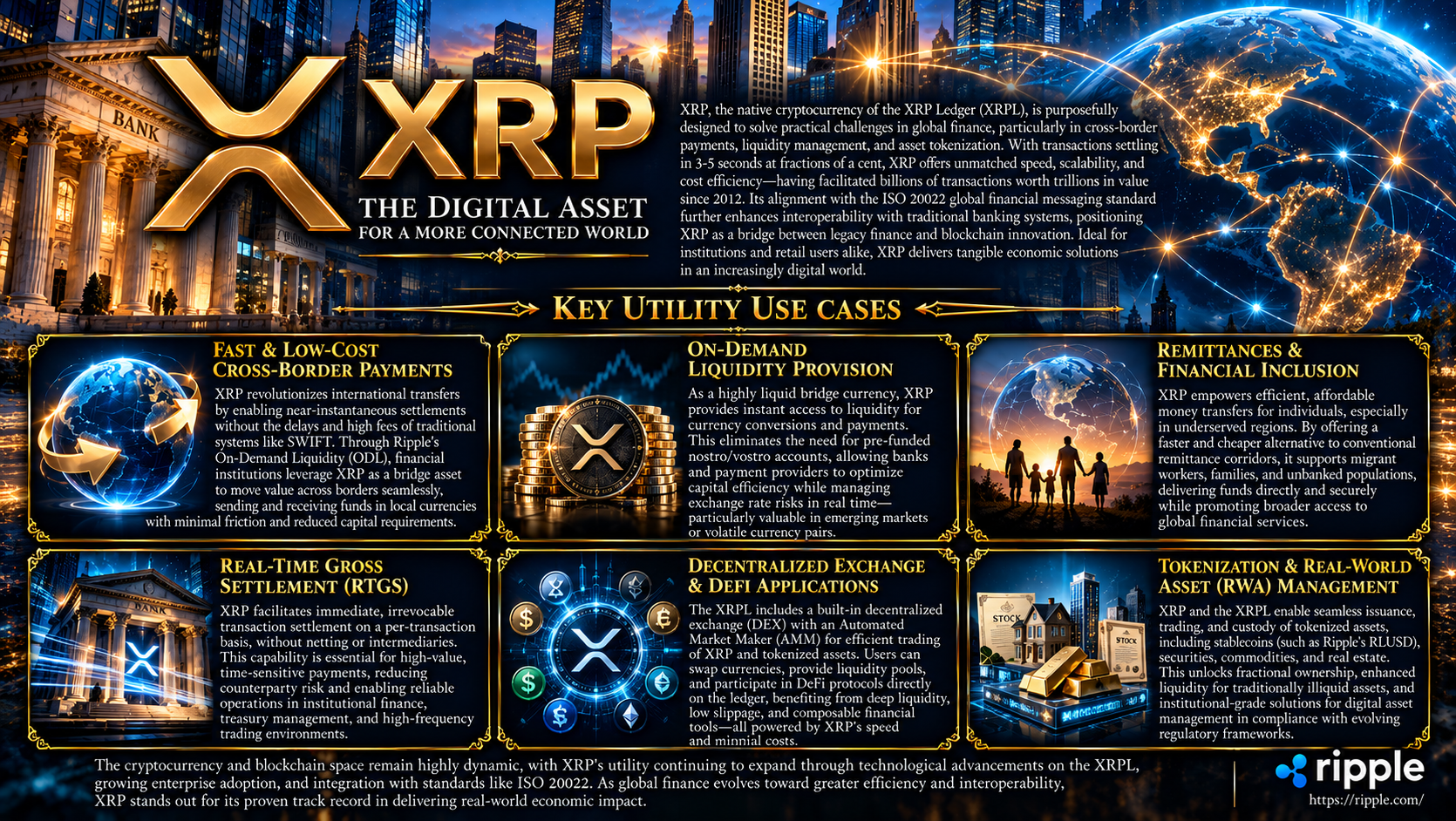
Ripple (XRP)

A Digital Asset with Proven Real-World Utility

XRP, the native cryptocurrency of the XRP Ledger (XRPL), is purposefully designed to solve practical challenges in global finance, particularly in cross-border payments, liquidity management, and asset tokenization. With transactions settling in 3-5 seconds at fractions of a cent, XRP offers unmatched speed, scalability, and cost efficiency—having facilitated billions of transactions worth trillions in value since 2012. Its alignment with the ISO 20022 global financial messaging standard further enhances interoperability with traditional banking systems, positioning XRP as a bridge between legacy finance and blockchain innovation. Ideal for institutions and retail users alike, XRP delivers tangible economic solutions in an increasingly digital world.

Key Utility Use Cases

Fast & Low-Cost Cross-Border Payments

XRP revolutionizes international transfers by enabling near-instantaneous settlements without the delays and high fees of traditional systems like SWIFT. Through Ripple's On-Demand Liquidity (ODL), financial institutions leverage XRP as a bridge asset to move value across borders seamlessly, sending and receiving funds in local currencies with minimal friction and reduced capital requirements.

On-Demand Liquidity Provision

As a highly liquid bridge currency, XRP provides instant access to liquidity for currency conversions and payments. This eliminates the need for pre-funded nostro/vostro accounts, allowing banks and payment providers to optimize capital efficiency while managing exchange rate risks in real time—particularly valuable in emerging markets or volatile currency pairs.

Remittances & Financial Inclusion

XRP empowers efficient, affordable money transfers for individuals, especially in underserved regions. By offering a faster and cheaper alternative to conventional remittance corridors, it supports migrant workers, families, and unbanked populations, delivering funds directly and securely while promoting broader access to global financial services.

Real-Time Gross Settlement (RTGS)

XRP facilitates immediate, irrevocable transaction settlement on a per-transaction basis, without netting or intermediaries. This capability is essential for high-value, time-sensitive payments, reducing counterparty risk and enabling reliable operations in institutional finance, treasury management, and high-frequency trading environments.

Decentralized Exchange & DeFi Applications

The XRPL includes a built-in decentralized exchange (DEX) with an Automated Market Maker (AMM) for efficient trading of XRP and tokenized assets. Users can swap currencies, provide liquidity pools, and participate in DeFi protocols directly on the ledger, benefiting from deep liquidity, low slippage, and composable financial tools—all powered by XRP's speed and minimal costs.

Tokenization & Real-World Asset (RWA) Management

XRP and the XRPL enable seamless issuance, trading, and custody of tokenized assets, including stablecoins (such as Ripple's RLUSD), securities, commodities, and real estate. This unlocks fractional ownership, enhanced liquidity for traditionally illiquid assets, and institutional-grade solutions for digital asset management in compliance with evolving regulatory frameworks.

The cryptocurrency and blockchain space remain highly dynamic, with XRP's utility continuing to expand through technological advancements on the XRPL, growing enterprise adoption, and integration with standards like ISO 20022. As global finance evolves toward greater efficiency and interoperability, XRP stands out for its proven track record in delivering real-world economic impact..

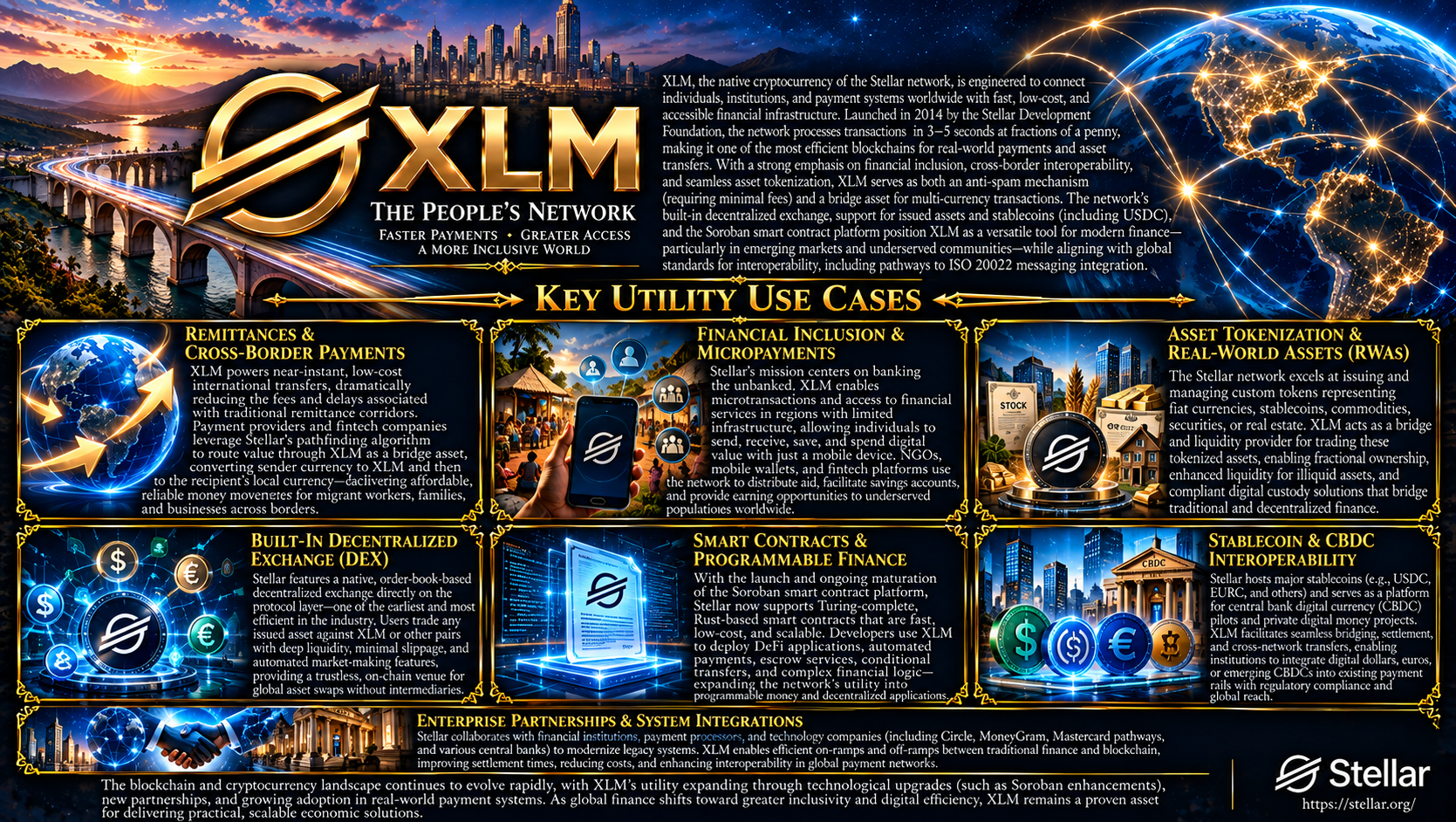
Stellar Lumens (XLM)

A Digital Asset for Inclusive & Efficient Global Finance

XLM, the native cryptocurrency of the Stellar network, is engineered to connect individuals, institutions, and payment systems worldwide with fast, low-cost, and accessible financial infrastructure. Launched in 2014 by the Stellar Development Foundation, the network processes transactions in 3–5 seconds at fractions of a penny, making it one of the most efficient blockchains for real-world payments and asset transfers. With a strong emphasis on financial inclusion, cross-border interoperability, and seamless asset tokenization, XLM serves as both an anti-spam mechanism (requiring minimal fees) and a bridge asset for multi-currency transactions. The network’s built-in decentralized exchange, support for issued assets and stablecoins (including USDC), and the Soroban smart contract platform position XLM as a versatile tool for modern finance—particularly in emerging markets and underserved communities—while aligning with global standards for interoperability, including pathways to ISO 20022 messaging integration.

Key Utility Use Cases

Remittances & Cross-Border Payments

XLM powers near-instant, low-cost international transfers, dramatically reducing the fees and delays associated with traditional remittance corridors. Payment providers and fintech companies leverage Stellar’s pathfinding algorithm to route value through XLM as a bridge asset, converting sender currency to XLM and then to the recipient’s local currency—delivering affordable, reliable money movement for migrant workers, families, and businesses across borders.

Financial Inclusion & Micropayments

Stellar’s mission centers on banking the unbanked. XLM enables microtransactions and access to financial services in regions with limited infrastructure, allowing individuals to send, receive, save, and spend digital value with just a mobile device. NGOs, mobile wallets, and fintech platforms use the network to distribute aid, facilitate savings accounts, and provide earning opportunities to underserved populations worldwide.

Asset Tokenization & Real-World Assets (RWAs)

The Stellar network excels at issuing and managing custom tokens representing fiat currencies, stablecoins, commodities, securities, or real estate. XLM acts as a bridge and liquidity provider for trading these tokenized assets, enabling fractional ownership, enhanced liquidity for illiquid assets, and compliant digital custody solutions that bridge traditional and decentralized finance.

Built-In Decentralized Exchange (DEX)

Stellar features a native, order-book-based decentralized exchange directly on the protocol layer—one of the earliest and most efficient in the industry. Users trade any issued asset against XLM or other pairs with deep liquidity, minimal slippage, and automated market-making features, providing a trustless, on-chain venue for global asset swaps without intermediaries.

Smart Contracts & Programmable Finance

With the launch and ongoing maturation of the Soroban smart contract platform, Stellar now supports Turing-complete, Rust-based smart contracts that are fast, low-cost, and scalable. Developers use XLM to deploy DeFi applications, automated payments, escrow services, conditional transfers, and complex financial logic—expanding the network’s utility into programmable money and decentralized applications.

Stablecoin & CBDC Interoperability

Stellar hosts major stablecoins (e.g., USDC, EURC, and others) and serves as a platform for central bank digital currency (CBDC) pilots and private digital money projects. XLM facilitates seamless bridging, settlement, and cross-network transfers, enabling institutions to integrate digital dollars, euros, or emerging CBDCs into existing payment rails with regulatory compliance and global reach.

Enterprise Partnerships & System Integrations

Stellar collaborates with financial institutions, payment processors, and technology companies (including Circle, MoneyGram, Mastercard pathways, and various central banks) to modernize legacy systems. XLM enables efficient on-ramps and off-ramps between traditional finance and blockchain, improving settlement times, reducing costs, and enhancing interoperability in global payment networks.

The blockchain and cryptocurrency landscape continues to evolve rapidly, with XLM’s utility expanding through technological upgrades (such as Soroban enhancements), new partnerships, and growing adoption in real-world payment systems. As global finance shifts toward greater inclusivity and digital efficiency, XLM remains a proven asset for delivering practical, scalable economic solutions.

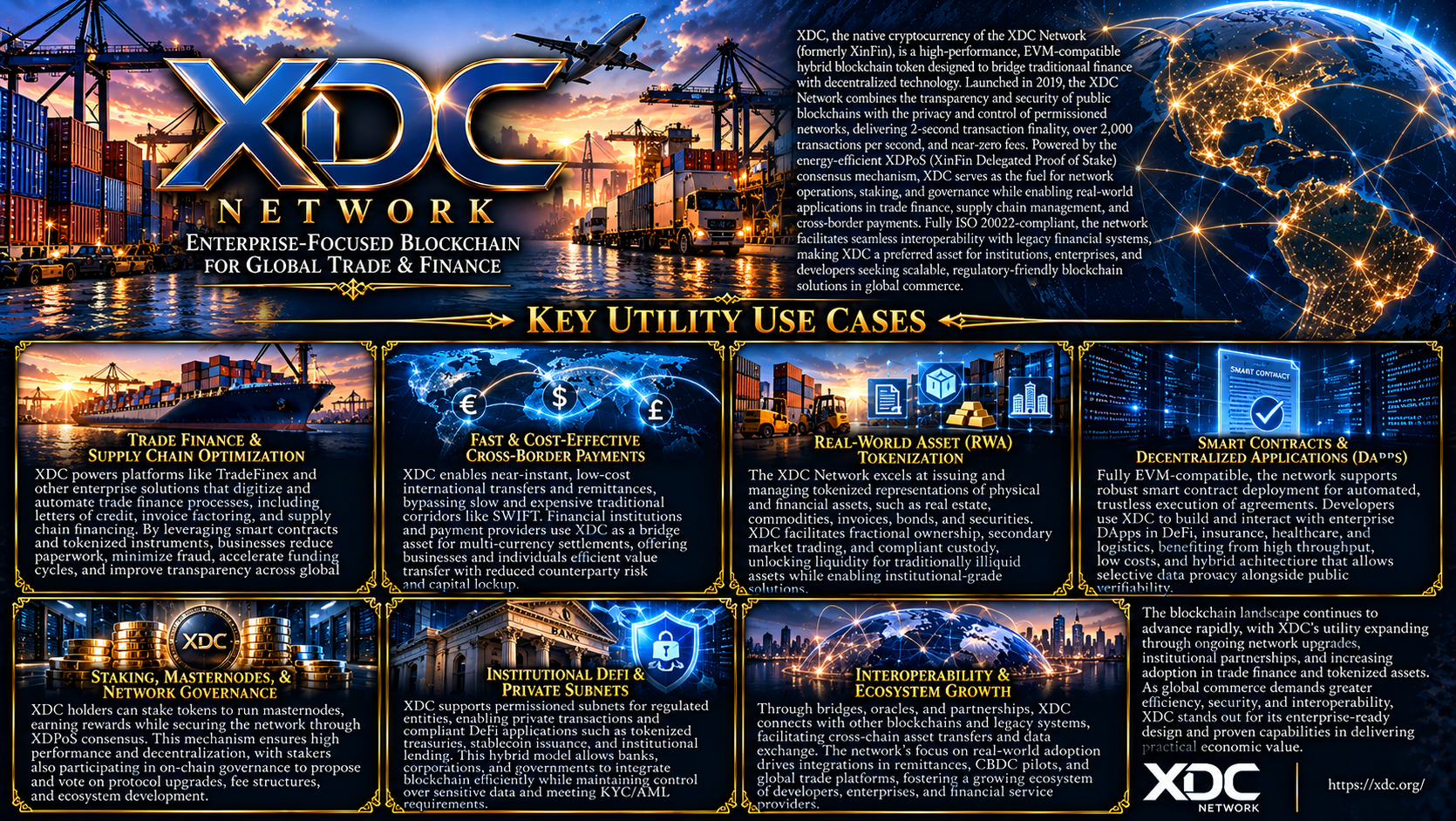
XinFin (XDC)

Enterprise-Focused Blockchain for Global Trade & Finance

XDC, the native cryptocurrency of the XDC Network (formerly XinFin), is a high-performance, EVM-compatible hybrid blockchain token designed to bridge traditional finance with decentralized technology. Launched in 2019, the XDC Network combines the transparency and security of public blockchains with the privacy and control of permissioned networks, delivering 2-second transaction finality, over 2,000 transactions per second, and near-zero fees. Powered by the energy-efficient XDPoS (XinFin Delegated Proof of Stake) consensus mechanism, XDC serves as the fuel for network operations, staking, and governance while enabling real-world applications in trade finance, supply chain management, and cross-border payments. Fully ISO 20022-compliant, the network facilitates seamless interoperability with legacy financial systems, making XDC a preferred asset for institutions, enterprises, and developers seeking scalable, regulatory-friendly blockchain solutions in global commerce.

Key Utility Use Cases

Trade Finance & Supply Chain Optimization

XDC powers platforms like TradeFinex and other enterprise solutions that digitize and automate trade finance processes, including letters of credit, invoice factoring, and supply chain financing. By leveraging smart contracts and tokenized instruments, businesses reduce paperwork, minimize fraud, accelerate funding cycles, and improve transparency across global supply chains—addressing inefficiencies that cost the industry billions annually.

Fast & Cost-Effective Cross-Border Payments

XDC enables near-instant, low-cost international transfers and remittances, bypassing slow and expensive traditional corridors like SWIFT. Financial institutions and payment providers use XDC as a bridge asset for multi-currency settlements, offering businesses and individuals efficient value transfer with reduced counterparty risk and capital lockup—particularly impactful in emerging markets and high-volume trade routes.

Real-World Asset (RWA) Tokenization

The XDC Network excels at issuing and managing tokenized representations of physical and financial assets, such as real estate, commodities, invoices, bonds, and securities. XDC facilitates fractional ownership, secondary market trading, and compliant custody, unlocking liquidity for traditionally illiquid assets while enabling institutional-grade solutions that align with regulatory frameworks.

Smart Contracts & Decentralized Applications (DApps)

Fully EVM-compatible, the network supports robust smart contract deployment for automated, trustless execution of agreements. Developers use XDC to build and interact with enterprise DApps in DeFi, insurance, healthcare, and logistics, benefiting from high throughput, low costs, and hybrid architecture that allows selective data privacy alongside public verifiability.

Staking, Masternodes, & Network Governance

XDC holders can stake tokens to run masternodes, earning rewards while securing the network through XDPoS consensus. This mechanism ensures high performance and decentralization, with stakers also participating in on-chain governance to propose and vote on protocol upgrades, fee structures, and ecosystem development—aligning incentives for long-term network health.

Institutional DeFi & Private Subnets

XDC supports permissioned subnets for regulated entities, enabling private transactions and compliant DeFi applications such as tokenized treasuries, stablecoin issuance, and institutional lending. This hybrid model allows banks, corporations, and governments to integrate blockchain efficiently while maintaining control over sensitive data and meeting KYC/AML requirements.

Interoperability & Ecosystem Growth

Through bridges, oracles, and partnerships, XDC connects with other blockchains and legacy systems, facilitating cross-chain asset transfers and data exchange. The network's focus on real-world adoption drives integrations in remittances, CBDC pilots, and global trade platforms, fostering a growing ecosystem of developers, enterprises, and financial service providers.

The blockchain landscape continues to advance rapidly, with XDC's utility expanding through ongoing network upgrades, institutional partnerships, and increasing adoption in trade finance and tokenized assets. As global commerce demands greater efficiency, security, and interoperability, XDC stands out for its enterprise-ready design and proven capabilities in delivering practical economic value..

Algorand (ALGO)

High-Performance Blockchain for Scalable, Secure, & Sustainable Finance

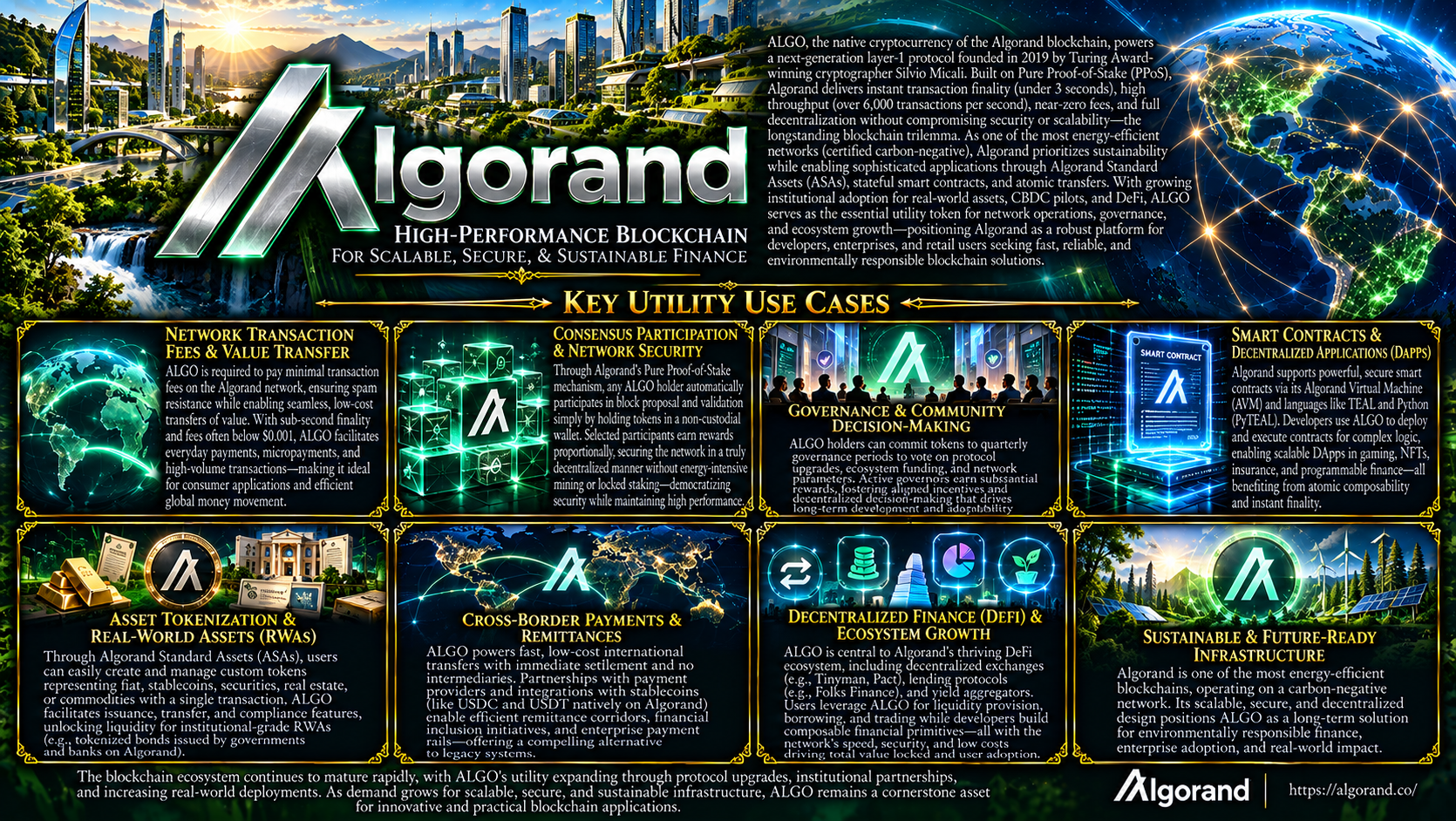
ALGO, the native cryptocurrency of the Algorand blockchain, powers a next-generation layer-1 protocol founded in 2019 by Turing Award-winning cryptographer Silvio Micali. Built on Pure Proof-of-Stake (PPoS), Algorand delivers instant transaction finality (under 3 seconds), high throughput (over 6,000 transactions per second), near-zero fees, and full decentralization without compromising security or scalability—the longstanding blockchain trilemma. As one of the most energy-efficient networks (certified carbon-negative), Algorand prioritizes sustainability while enabling sophisticated applications through Algorand Standard Assets (ASAs), stateful smart contracts, and atomic transfers. With growing institutional adoption for real-world assets, CBDC pilots, and DeFi, ALGO serves as the essential utility token for network operations, governance, and ecosystem growth—positioning Algorand as a robust platform for developers, enterprises, and retail users seeking fast, reliable, and environmentally responsible blockchain solutions.

Key Utility Use Cases

Network Transaction Fees & Value Transfer

ALGO is required to pay minimal transaction fees on the Algorand network, ensuring spam resistance while enabling seamless, low-cost transfers of value. With sub-second finality and fees often below $0.001, ALGO facilitates everyday payments, micropayments, and high-volume transactions—making it ideal for consumer applications and efficient global money movement.

Consensus Participation & Network Security

Through Algorand's Pure Proof-of-Stake mechanism, any ALGO holder automatically participates in block proposal and validation simply by holding tokens in a non-custodial wallet. Selected participants earn rewards proportionally, securing the network in a truly decentralized manner without energy-intensive mining or locked staking—democratizing security while maintaining high performance.

Governance & Community Decision-Making

ALGO holders can commit tokens to quarterly governance periods to vote on protocol upgrades, ecosystem funding, and network parameters. Active governors earn substantial rewards, fostering aligned incentives and decentralized decision-making that drives long-term development and adaptability of the Algorand platform.

Smart Contracts & Decentralized Applications (DApps)

Algorand supports powerful, secure smart contracts via its Algorand Virtual Machine (AVM) and languages like TEAL and Python (PyTEAL). Developers use ALGO to deploy and execute contracts for complex logic, enabling scalable DApps in gaming, NFTs, insurance, and programmable finance—all benefiting from atomic composability and instant finality.

Asset Tokenization & Real-World Assets (RWAs)

Through Algorand Standard Assets (ASAs), users can easily create and manage custom tokens representing fiat, stablecoins, securities, real estate, or commodities with a single transaction. ALGO facilitates issuance, transfer, and compliance features, unlocking liquidity for institutional-grade RWAs (e.g., tokenized bonds issued by governments and banks on Algorand).

Cross-Border Payments & Remittances

ALGO powers fast, low-cost international transfers with immediate settlement and no intermediaries. Partnerships with payment providers and integrations with stablecoins (like USDC and USDT natively on Algorand) enable efficient remittance corridors, financial inclusion initiatives, and enterprise payment rails—offering a compelling alternative to legacy systems.

Decentralized Finance (DeFi) & Ecosystem Growth

ALGO is central to Algorand's thriving DeFi ecosystem, including decentralized exchanges (e.g., Tinyman, Pact), lending protocols (e.g., Folks Finance), and yield aggregators. Users leverage ALGO for liquidity provision, borrowing, and trading while developers build composable financial primitives—all with the network's speed, security, and low costs driving total value locked and user adoption.

The blockchain ecosystem continues to mature rapidly, with ALGO's utility expanding through protocol upgrades (such as enhanced state proofs for interoperability), institutional partnerships, and increasing real-world deployments. As demand grows for scalable, secure, and sustainable infrastructure, ALGO remains a cornerstone asset for innovative and practical blockchain applications.

Hedera Hashgraph (HBAR)

Enterprise-Grade Distributed Ledger for Secure, Scalable, & Sustainable Applications

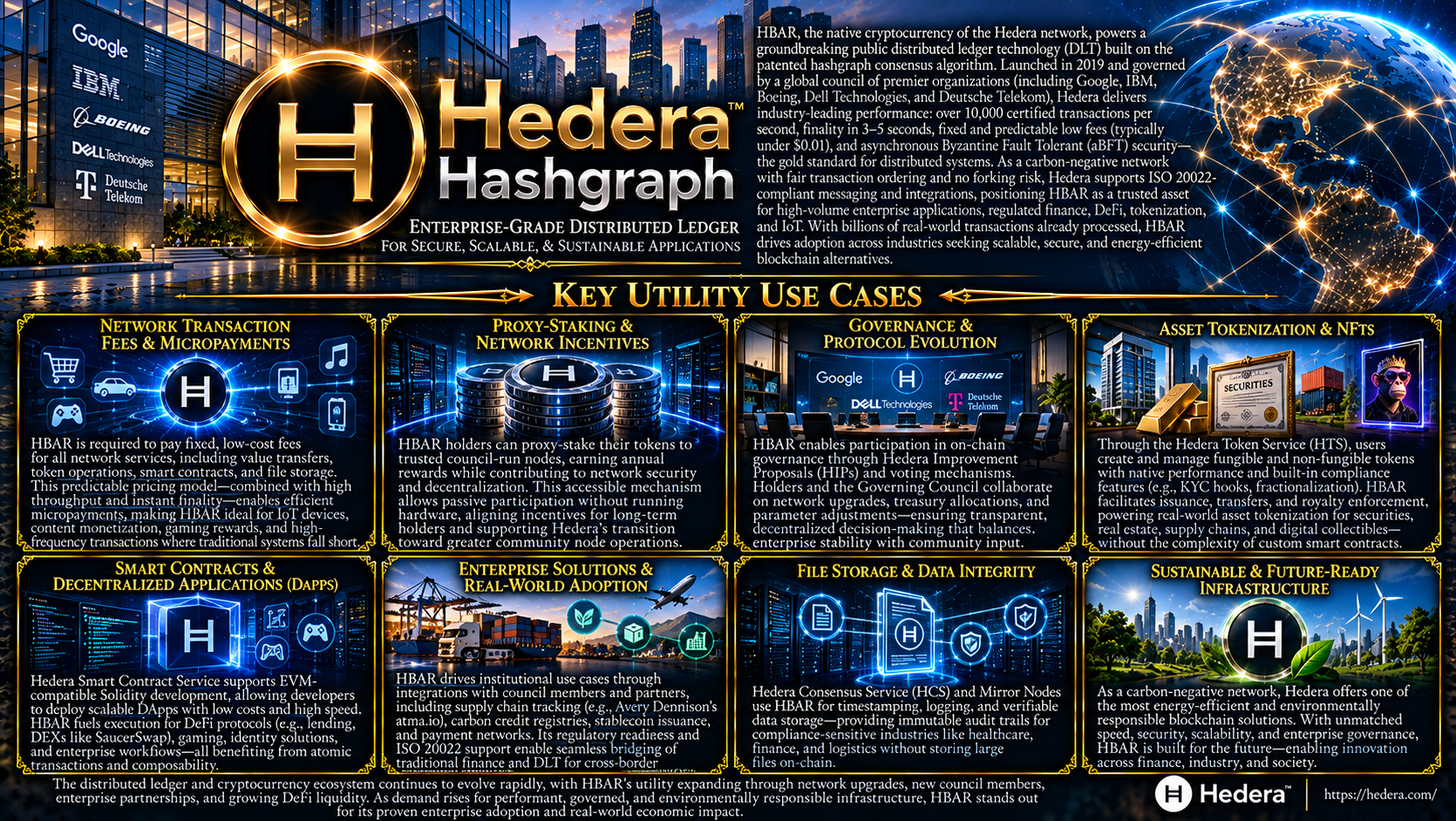
HBAR, the native cryptocurrency of the Hedera network, powers a groundbreaking public distributed ledger technology (DLT) built on the patented hashgraph consensus algorithm. Launched in 2019 and governed by a global council of premier organizations (including Google, IBM, Boeing, Dell Technologies, and Deutsche Telekom), Hedera delivers industry-leading performance: over 10,000 certified transactions per second, finality in 3–5 seconds, fixed and predictable low fees (typically under $0.01), and asynchronous Byzantine Fault Tolerant (aBFT) security—the gold standard for distributed systems. As a carbon-negative network with fair transaction ordering and no forking risk, Hedera supports ISO 20022-compliant messaging and integrations, positioning HBAR as a trusted asset for high-volume enterprise applications, regulated finance, DeFi, tokenization, and IoT. With billions of real-world transactions already processed, HBAR drives adoption across industries seeking scalable, secure, and energy-efficient blockchain alternatives.

Key Utility Use Cases

Network Transaction Fees & Micropayments

HBAR is required to pay fixed, low-cost fees for all network services, including value transfers, token operations, smart contracts, and file storage. This predictable pricing model—combined with high throughput and instant finality—enables efficient micropayments, making HBAR ideal for IoT devices, content monetization, gaming rewards, and high-frequency transactions where traditional systems fall short.

Proxy-Staking & Network Incentives

HBAR holders can proxy-stake their tokens to trusted council-run nodes, earning annual rewards while contributing to network security and decentralization. This accessible mechanism allows passive participation without running hardware, aligning incentives for long-term holders and supporting Hedera's transition toward greater community node operations.

Governance & Protocol Evolution

HBAR enables participation in on-chain governance through Hedera Improvement Proposals (HIPs) and voting mechanisms. Holders and the Governing Council collaborate on network upgrades, treasury allocations, and parameter adjustments—ensuring transparent, decentralized decision-making that balances enterprise stability with community input.

Asset Tokenization & NFTs

Through the Hedera Token Service (HTS), users create and manage fungible and non-fungible tokens with native performance and built-in compliance features (e.g., KYC hooks, fractionalization). HBAR facilitates issuance, transfers, and royalty enforcement, powering real-world asset tokenization for securities, real estate, supply chains, and digital collectibles—without the complexity of custom smart contracts.

Smart Contracts & Decentralized Applications (DApps)

Hedera Smart Contract Service supports EVM-compatible Solidity development, allowing developers to deploy scalable DApps with low costs and high speed. HBAR fuels execution for DeFi protocols (e.g., lending, DEXs like SaucerSwap), gaming, identity solutions, and enterprise workflows—all benefiting from atomic transactions and composability.

Enterprise Solutions & Real-World Adoption

HBAR drives institutional use cases through integrations with council members and partners, including supply chain tracking (e.g., Avery Dennison's atma.io), carbon credit registries, stablecoin issuance, and payment networks. Its regulatory readiness and ISO 20022 support enable seamless bridging of traditional finance and DLT for cross-border settlements, CBDC pilots, and tokenized treasuries.

File Storage & Data Integrity

Hedera Consensus Service (HCS) and Mirror Nodes use HBAR for timestamping, logging, and verifiable data storage—providing immutable audit trails for compliance-sensitive industries like healthcare, finance, and logistics without storing large files on-chain.

The distributed ledger and cryptocurrency ecosystem continues to evolve rapidly, with HBAR's utility expanding through network upgrades, new council members, enterprise partnerships, and growing DeFi liquidity. As demand rises for performant, governed, and environmentally responsible infrastructure, HBAR stands out for its proven enterprise adoption and real-world economic impact.

Cardano (ADA)

Research-Driven Blockchain for Sustainable, Scalable, & Inclusive Finance

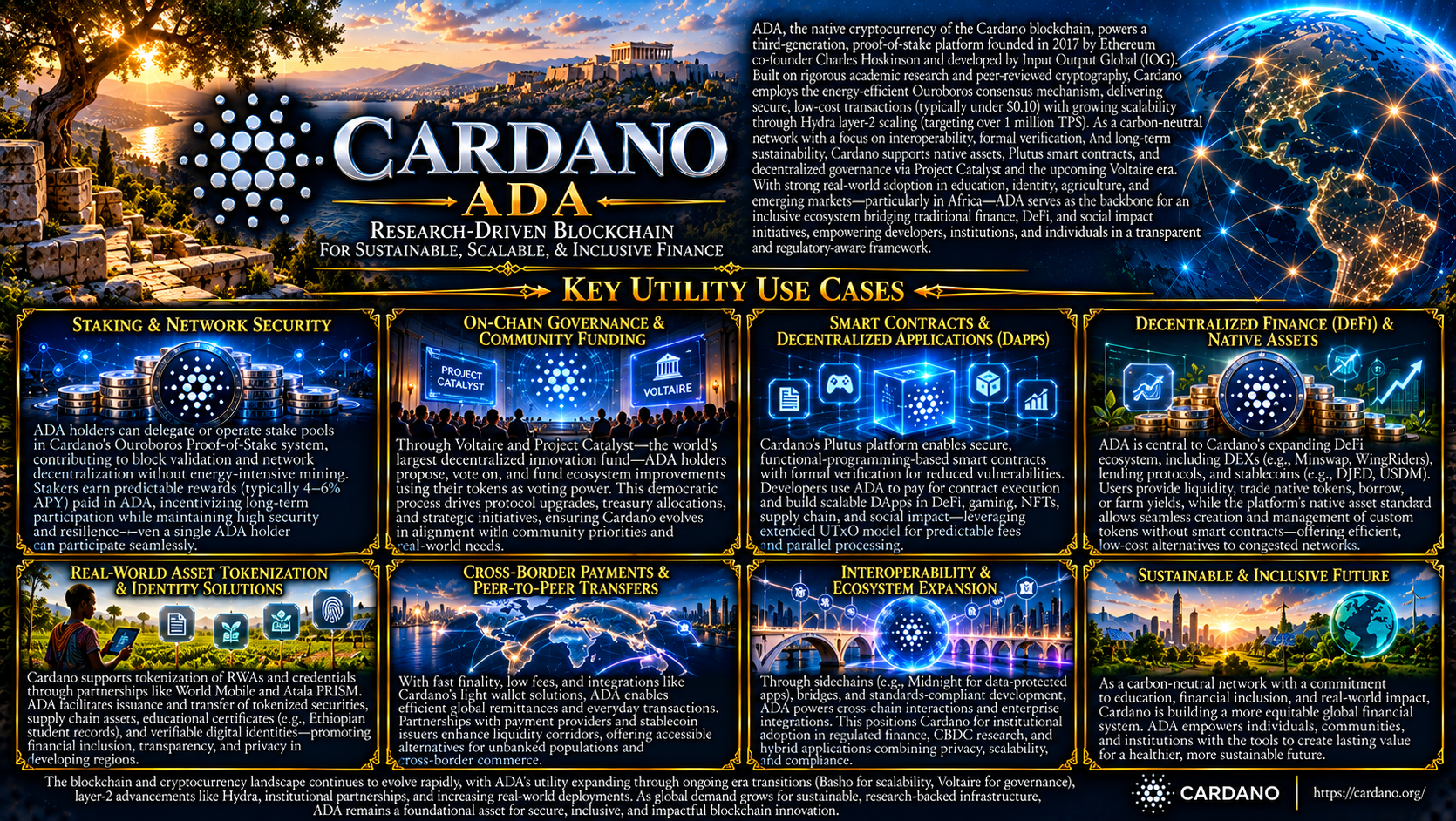
ADA, the native cryptocurrency of the Cardano blockchain, powers a third-generation, proof-of-stake platform founded in 2017 by Ethereum co-founder Charles Hoskinson and developed by Input Output Global (IOG). Built on rigorous academic research and peer-reviewed cryptography, Cardano employs the energy-efficient Ouroboros consensus mechanism, delivering secure, low-cost transactions (typically under $0.10) with growing scalability through Hydra layer-2 scaling (targeting over 1 million TPS). As a carbon-neutral network with a focus on interoperability, formal verification, and long-term sustainability, Cardano supports native assets, Plutus smart contracts, and decentralized governance via Project Catalyst and the upcoming Voltaire era. With strong real-world adoption in education, identity, agriculture, and emerging markets—particularly in Africa—ADA serves as the backbone for a inclusive ecosystem bridging traditional finance, DeFi, and social impact initiatives, empowering developers, institutions, and individuals in a transparent and regulatory-aware framework.

Key Utility Use Cases

Staking & Network Security

ADA holders can delegate or operate stake pools in Cardano's Ouroboros Proof-of-Stake system, contributing to block validation and network decentralization without energy-intensive mining. Stakers earn predictable rewards (typically 4–6% APY) paid in ADA, incentivizing long-term participation while maintaining high security and resilience—even a single ADA holder can participate seamlessly.

On-Chain Governance & Community Funding

Through Voltaire and Project Catalyst—the world's largest decentralized innovation fund—ADA holders propose, vote on, and fund ecosystem improvements using their tokens as voting power. This democratic process drives protocol upgrades, treasury allocations, and strategic initiatives, ensuring Cardano evolves in alignment with community priorities and real-world needs.

Smart Contracts & Decentralized Applications (DApps)

Cardano's Plutus platform enables secure, functional-programming-based smart contracts with formal verification for reduced vulnerabilities. Developers use ADA to pay for contract execution and build scalable DApps in DeFi, gaming, NFTs, supply chain, and social impact—leveraging extended UTxO model for predictable fees and parallel processing.

Decentralized Finance (DeFi) & Native Assets

ADA is central to Cardano's expanding DeFi ecosystem, including DEXs (e.g., Minswap, WingRiders), lending protocols, and stablecoins (e.g., DJED, USDM). Users provide liquidity, trade native tokens, borrow, or farm yields, while the platform's native asset standard allows seamless creation and management of custom tokens without smart contracts—offering efficient, low-cost alternatives to congested networks.

Real-World Asset Tokenization & Identity Solutions

Cardano supports tokenization of RWAs and credentials through partnerships like World Mobile and Atala PRISM. ADA facilitates issuance and transfer of tokenized securities, supply chain assets, educational certificates (e.g., Ethiopian student records), and verifiable digital identities—promoting financial inclusion, transparency, and privacy in developing regions.

Cross-Border Payments & Peer-to-Peer Transfers

With fast finality, low fees, and integrations like Cardano's light wallet solutions, ADA enables efficient global remittances and everyday transactions. Partnerships with payment providers and stablecoin issuers enhance liquidity corridors, offering accessible alternatives for unbanked populations and cross-border commerce.

Interoperability & Ecosystem Expansion

Through sidechains (e.g., Midnight for data-protected apps), bridges, and standards-compliant development, ADA powers cross-chain interactions and enterprise integrations. This positions Cardano for institutional adoption in regulated finance, CBDC research, and hybrid applications combining privacy, scalability, and compliance.

The blockchain and cryptocurrency landscape continues to evolve rapidly, with ADA's utility expanding through ongoing era transitions (Basho for scalability, Voltaire for governance), layer-2 advancements like Hydra, institutional partnerships, and increasing real-world deployments. As global demand grows for sustainable, research-backed infrastructure, ADA remains a foundational asset for secure, inclusive, and impactful blockchain innovation.

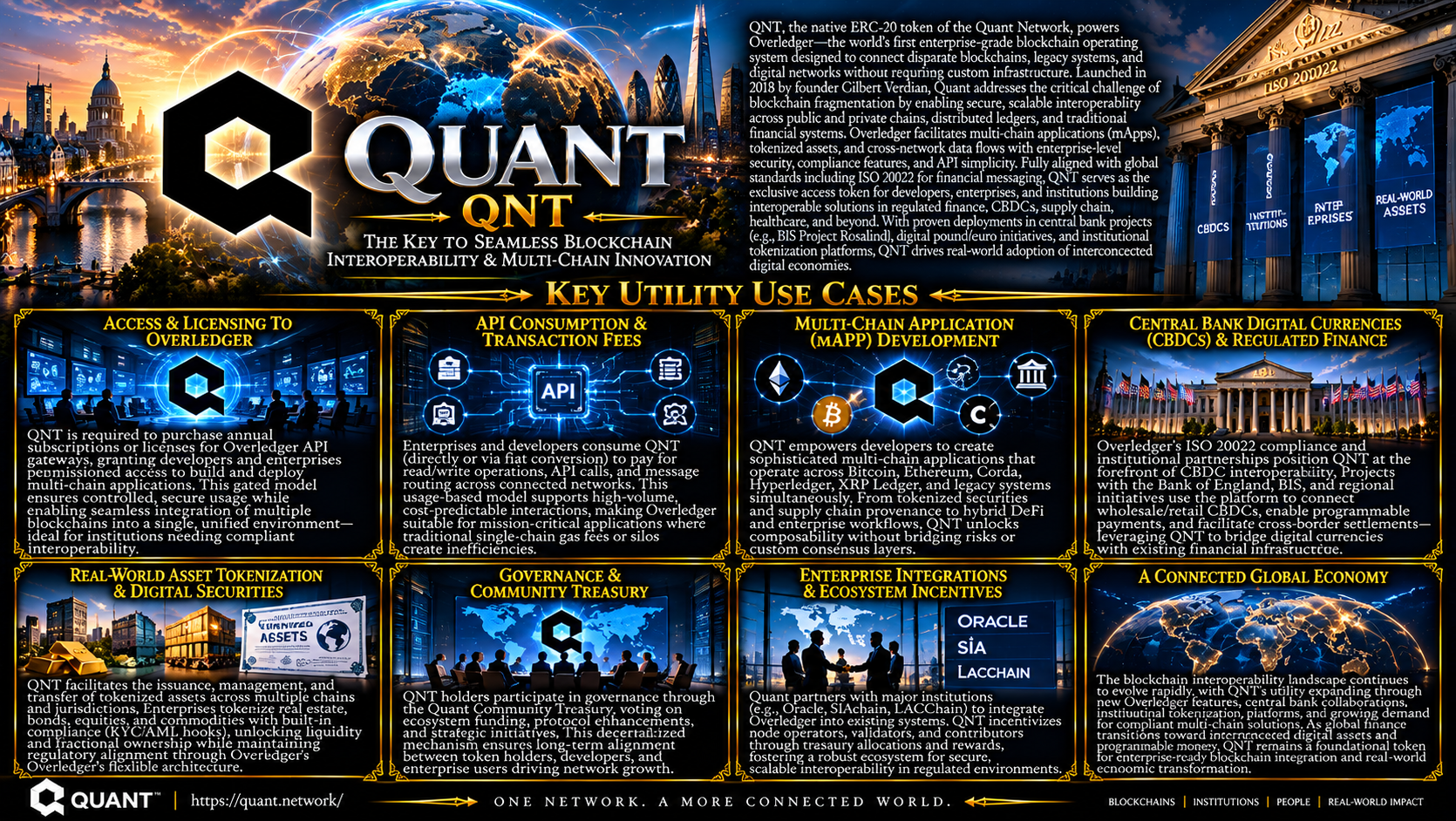
Quant (QNT)

The Key to Seamless Blockchain Interoperability & Multi-Chain Innovation

QNT, the native ERC-20 token of the Quant Network, powers Overledger—the world's first enterprise-grade blockchain operating system designed to connect disparate blockchains, legacy systems, and digital networks without requiring custom infrastructure. Launched in 2018 by founder Gilbert Verdian, Quant addresses the critical challenge of blockchain fragmentation by enabling secure, scalable interoperability across public and private chains, distributed ledgers, and traditional financial systems. Overledger facilitates multi-chain applications (mApps), tokenized assets, and cross-network data flows with enterprise-level security, compliance features, and API simplicity. Fully aligned with global standards including ISO 20022 for financial messaging, QNT serves as the exclusive access token for developers, enterprises, and institutions building interoperable solutions in regulated finance, CBDCs, supply chain, healthcare, and beyond. With proven deployments in central bank projects (e.g., BIS Project Rosalind), digital pound/euro initiatives, and institutional tokenization platforms, QNT drives real-world adoption of interconnected digital economies.

Key Utility Use Cases

Access & Licensing to Overledger

QNT is required to purchase annual subscriptions or licenses for Overledger API gateways, granting developers and enterprises permissioned access to build and deploy multi-chain applications. This gated model ensures controlled, secure usage while enabling seamless integration of multiple blockchains into a single, unified environment—ideal for institutions needing compliant interoperability.

API Consumption & Transaction Fees

Enterprises and developers consume QNT (directly or via fiat conversion) to pay for read/write operations, API calls, and message routing across connected networks. This usage-based model supports high-volume, cost-predictable interactions, making Overledger suitable for mission-critical applications where traditional single-chain gas fees or silos create inefficiencies.

Multi-Chain Application (mApp) Development

QNT empowers developers to create sophisticated multi-chain applications that operate across Bitcoin, Ethereum, Corda, Hyperledger, XRP Ledger, and legacy systems simultaneously. From tokenized securities and supply chain provenance to hybrid DeFi and enterprise workflows, QNT unlocks composability without bridging risks or custom consensus layers.

Central Bank Digital Currencies (CBDCs) & Regulated Finance

Overledger's ISO 20022 compliance and institutional partnerships position QNT at the forefront of CBDC interoperability. Projects with the Bank of England, BIS, and regional initiatives use the platform to connect wholesale/retail CBDCs, enable programmable payments, and facilitate cross-border settlements—leveraging QNT to bridge digital currencies with existing financial infrastructure.

Real-World Asset Tokenization & Digital Securities

QNT facilitates the issuance, management, and transfer of tokenized assets across multiple chains and jurisdictions. Enterprises tokenize real estate, bonds, equities, and commodities with built-in compliance (KYC/AML hooks), unlocking liquidity and fractional ownership while maintaining regulatory alignment through Overledger's flexible architecture.

Governance & Community Treasury

QNT holders participate in governance through the Quant Community Treasury, voting on ecosystem funding, protocol enhancements, and strategic initiatives. This decentralized mechanism ensures long-term alignment between token holders, developers, and enterprise users driving network growth.

Enterprise Integrations & Ecosystem Incentives

Quant partners with major institutions (e.g., Oracle, SIAchain, LACChain) to integrate Overledger into existing systems. QNT incentivizes node operators, validators, and contributors through treasury allocations and rewards, fostering a robust ecosystem for secure, scalable interoperability in regulated environments.

The blockchain interoperability landscape continues to evolve rapidly, with QNT's utility expanding through new Overledger features, central bank collaborations, institutional tokenization platforms, and growing demand for compliant multi-chain solutions. As global finance transitions toward interconnected digital assets and programmable money, QNT remains a foundational token for enterprise-ready blockchain integration and real-world economic transformation.

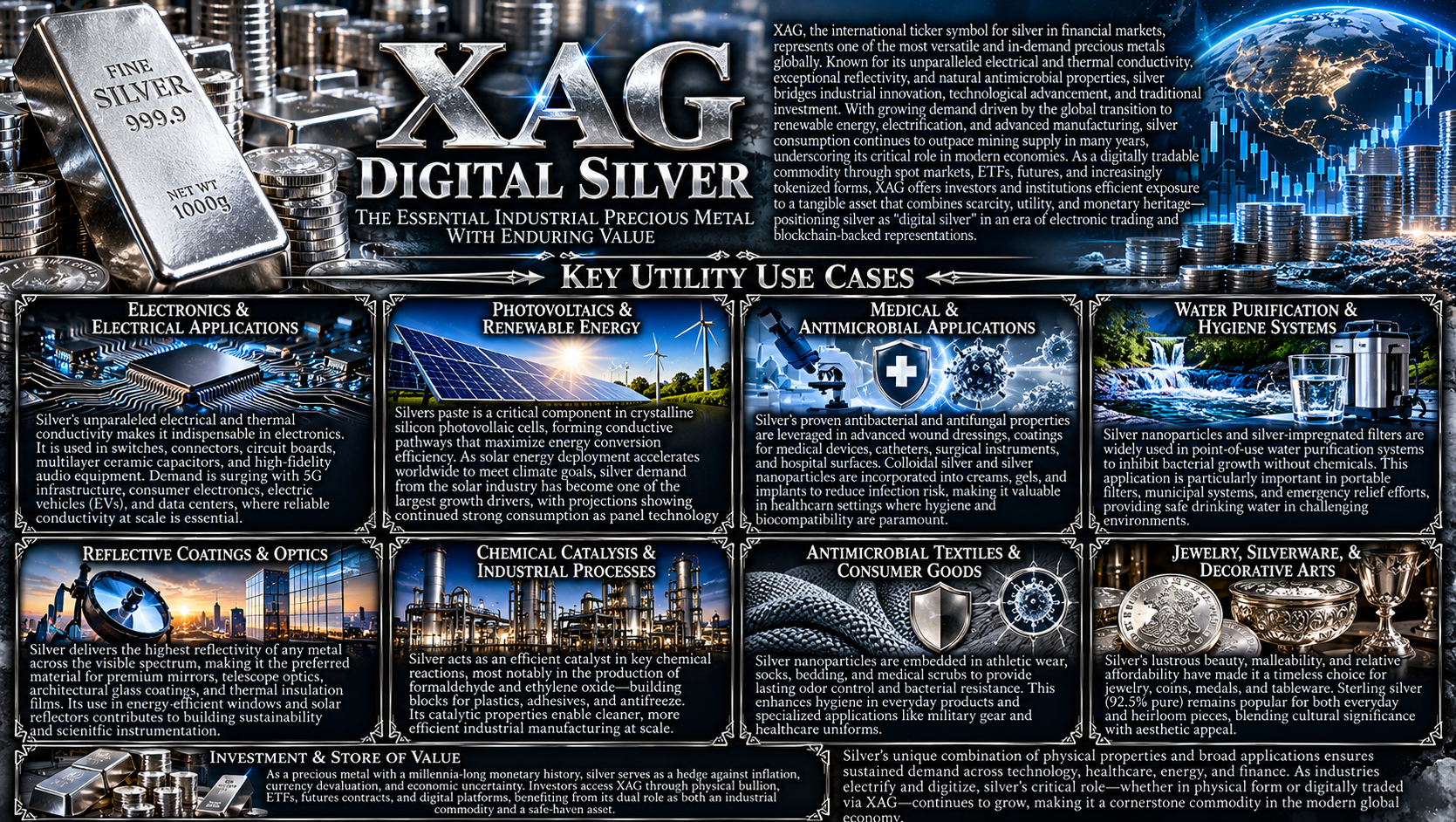
Digital Silver (XAG)

The Essential Industrial Precious Metal with Enduring Value

XAG, the international ticker symbol for silver in financial markets, represents one of the most versatile and in-demand precious metals globally. Known for its unparalleled electrical and thermal conductivity, exceptional reflectivity, and natural antimicrobial properties, silver bridges industrial innovation, technological advancement, and traditional investment. With growing demand driven by the global transition to renewable energy, electrification, and advanced manufacturing, silver consumption continues to outpace mining supply in many years, underscoring its critical role in modern economies. As a digitally tradable commodity through spot markets, ETFs, futures, and increasingly tokenized forms, XAG offers investors and institutions efficient exposure to a tangible asset that combines scarcity, utility, and monetary heritage—positioning silver as "digital silver" in an era of electronic trading and blockchain-backed representations.

Key Utility Use Cases

Electronics & Electrical Applications

Silver's status as the most electrically and thermally conductive metal makes it indispensable in electronics. It is used in switches, connectors, circuit boards, multilayer ceramic capacitors, and high-fidelity audio equipment. Demand is surging with the proliferation of 5G infrastructure, consumer electronics, electric vehicles (EVs), and data centers, where reliable conductivity at scale is essential.

Photovoltaics & Renewable Energy

Silver paste is a critical component in crystalline silicon photovoltaic cells, forming conductive pathways that maximize energy conversion efficiency. As solar energy deployment accelerates worldwide to meet climate goals, silver demand from the solar industry has become one of the largest growth drivers, with projections showing continued strong consumption as panel technology advances.

Medical & Antimicrobial Applications

Silver's proven antibacterial and antifungal properties are leveraged in advanced wound dressings, coatings for medical devices, catheters, surgical instruments, and hospital surfaces. Colloidal silver and silver nanoparticles are incorporated into creams, gels, and implants to reduce infection risk, making it valuable in healthcare settings where hygiene and biocompatibility are paramount.

Water Purification & Hygiene Systems

Silver nanoparticles and silver-impregnated filters are widely used in point-of-use water purification systems to inhibit bacterial growth without chemicals. This application is particularly important in portable filters, municipal systems, and emergency relief efforts, providing safe drinking water in challenging environments.

Reflective Coatings & Optics

Silver delivers the highest reflectivity of any metal across the visible spectrum, making it the preferred material for premium mirrors, telescope optics, architectural glass coatings, and thermal insulation films. Its use in energy-efficient windows and solar reflectors contributes to building sustainability and scientific instrumentation.

Chemical Catalysis & Industrial Processes

Silver acts as an efficient catalyst in key chemical reactions, most notably in the production of formaldehyde and ethylene oxide—building blocks for plastics, adhesives, and antifreeze. Its catalytic properties enable cleaner, more efficient industrial manufacturing at scale.

Antimicrobial Textiles & Consumer Goods

Silver nanoparticles are embedded in athletic wear, socks, bedding, and medical scrubs to provide lasting odor control and bacterial resistance. This enhances hygiene in everyday products and specialized applications like military gear and healthcare uniforms.

Jewelry, Silverware, & Decorative Arts

Silver's lustrous beauty, malleability, and relative affordability have made it a timeless choice for jewelry, coins, medals, and tableware. Sterling silver (92.5% pure) remains popular for both everyday and heirloom pieces, blending cultural significance with aesthetic appeal.

Investment & Store of Value

As a precious metal with a millennia-long monetary history, silver serves as a hedge against inflation, currency devaluation, and economic uncertainty. Investors access XAG through physical bullion, ETFs, futures contracts, and digital platforms, benefiting from its dual role as both an industrial commodity and a safe-haven asset.

Silver's unique combination of physical properties and broad applications ensures sustained demand across technology, healthcare, energy, and finance. As industries electrify and digitize, silver's critical role—whether in physical form or digitally traded via XAG—continues to grow, making it a cornerstone commodity in the modern global economy.

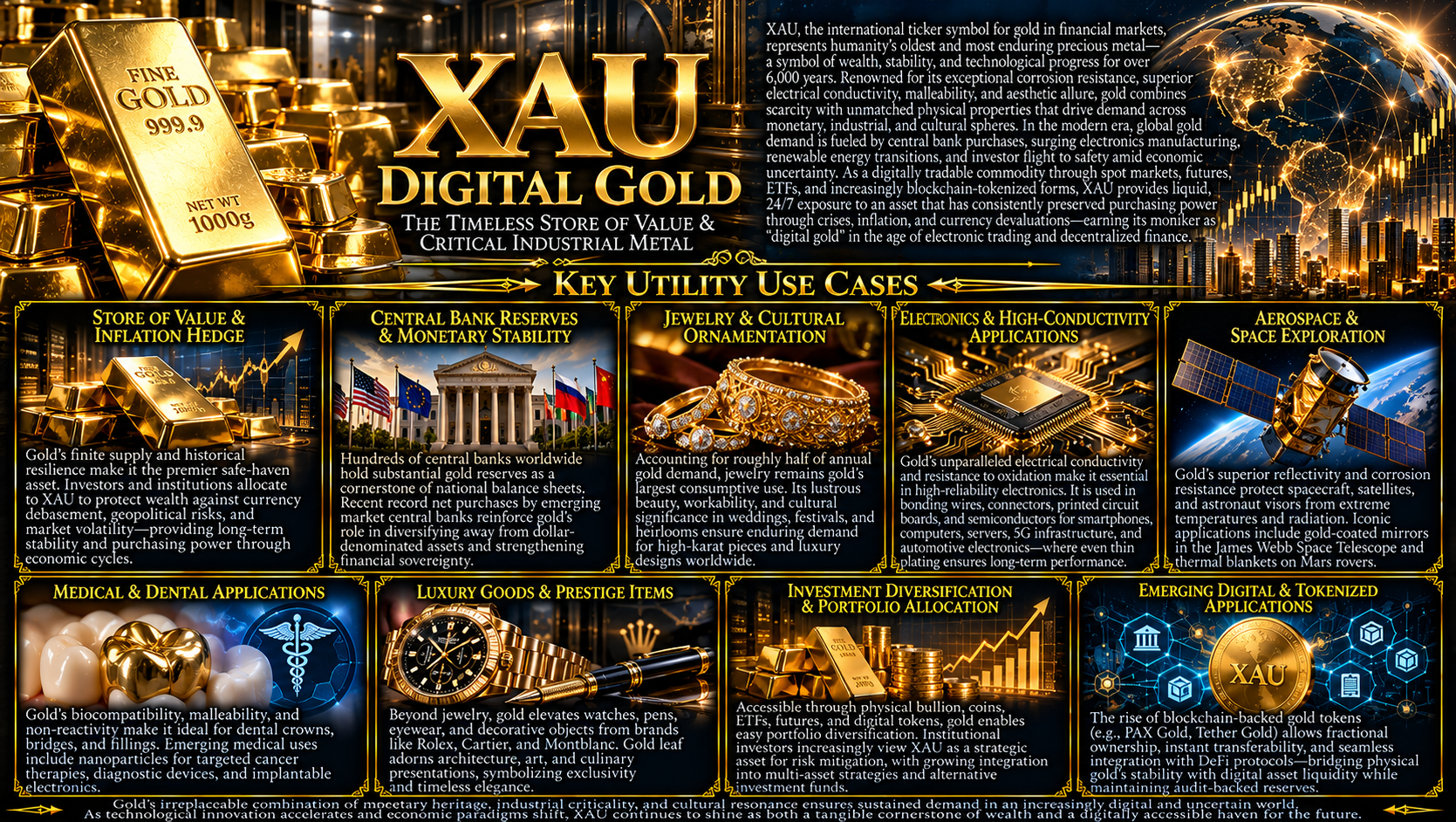
Digital Gold (XAU)

The Timeless Store of Value & Critical Industrial Metal

XAU, the international ticker symbol for gold in financial markets, represents humanity's oldest and most enduring precious metal—a symbol of wealth, stability, and technological progress for over 6,000 years. Renowned for its exceptional corrosion resistance, superior electrical conductivity, malleability, and aesthetic allure, gold combines scarcity with unmatched physical properties that drive demand across monetary, industrial, and cultural spheres. In the modern era, global gold demand is fueled by central bank purchases (at multi-decade highs), surging electronics manufacturing, renewable energy transitions, and investor flight to safety amid economic uncertainty. As a digitally tradable commodity through spot markets, futures, ETFs (e.g., GLD, IAU), and increasingly blockchain-tokenized forms (e.g., PAXG, Tether Gold), XAU provides liquid, 24/7 exposure to an asset that has consistently preserved purchasing power through crises, inflation, and currency devaluations—earning its moniker as "digital gold" in the age of electronic trading and decentralized finance.

Key Utility Use Cases

Store of Value & Inflation Hedge

Gold's finite supply and historical resilience make it the premier safe-haven asset. Investors and institutions allocate to XAU to protect wealth against currency debasement, geopolitical risks, and market volatility—evidenced by strong performance during economic downturns and its inverse correlation with fiat currencies.

Central Bank Reserves & Monetary Stability

Hundreds of central banks, including those of the United States, Germany, China, and India, hold substantial gold reserves as a cornerstone of national balance sheets. Recent years have seen record net purchases by emerging market central banks, reinforcing gold's role in diversifying away from dollar-denominated assets and bolstering financial sovereignty.

Jewelry & Cultural Ornamentation

Accounting for roughly half of annual gold demand, jewelry remains gold's largest consumptive use—particularly in India, China, and the Middle East. Its lustrous beauty, workability, and cultural significance in weddings, festivals, and heirlooms ensure enduring demand for high-karat pieces and luxury designs.

Electronics & High-Conductivity Applications

Gold's unparalleled electrical conductivity and resistance to oxidation make it essential in high-reliability electronics. It is used in bonding wires, connectors, printed circuit boards, and semiconductors for smartphones, computers, servers, 5G infrastructure, and automotive electronics—where even thin plating ensures long-term performance.

Aerospace & Space Exploration

Gold's superior reflectivity (reflecting 98% of infrared radiation) and corrosion resistance protect spacecraft, satellites, and astronaut visors from extreme temperatures and radiation. Iconic applications include gold-coated mirrors in the James Webb Space Telescope and thermal blankets on Mars rovers.

Medical & Dental Applications

Gold's biocompatibility, malleability, and non-reactivity make it ideal for dental crowns, bridges, and fillings—providing durable, hypoallergenic restorations. Emerging medical uses include nanoparticles for targeted cancer therapies, diagnostic devices, and implantable electronics.

Luxury Goods & Prestige Items

Beyond jewelry, gold elevates watches, pens, eyewear, and decorative objects from brands like Rolex, Cartier, and Montblanc. Gold leaf adorns architecture, art, and culinary presentations, symbolizing exclusivity and timeless elegance.

Investment Diversification & Portfolio Allocation

Accessible through physical bullion, coins, ETFs, futures, and digital tokens, gold enables easy portfolio diversification. Institutional investors increasingly view XAU as a strategic asset for risk mitigation, with growing integration into multi-asset strategies and alternative investment funds.

Emerging Digital & Tokenized Applications

The rise of blockchain-backed gold tokens (e.g., PAX Gold, Tether Gold) allows fractional ownership, instant transferability, and seamless integration with DeFi protocols—bridging physical gold's stability with digital asset liquidity while maintaining audit-backed reserves.

Gold's irreplaceable combination of monetary heritage, industrial criticality, and cultural resonance ensures sustained demand in an increasingly digital and uncertain world. As technological innovation accelerates and economic paradigms shift, XAU continues to shine as both a tangible cornerstone of wealth and a digitally accessible haven for the future.